Werelden – Een Reeks Kosmische Beelden

Door Bô Yin Râ (1876 – 1943), vertaald door M. ter Marsch-Keen en bewerkt door Pieter M.G. van Exter.
91 Pagina’s | Uitgegeven in 1964, tweede druk 2004, incl. afbeeldingen | Hardcover | Aurora Productions, Zuid-Scharwoude | ISBN: 9073007186.
Duits origineel: Welten | Uitgegeven in 1922 | Rhein-Verlag, Basel | ISBN: 9783857670886.
Bô Yin Râ is de geestelijke naam van de Duitse schrijver en kunstschilder Joseph Anton Schneiderfranken, die leefde van 1876 – 1943. Zijn hoofdwerk bestaat uit tweeëndertig boeken met een ethisch-religieuze inhoud, die gedurende de jaren 1919-1936 verschenen. Zonder een school of een nieuw ‘systeem van denken of geloven’ te verkondigen, toont Bô Yin Râ vanuit verschillende gezichtspunten de weg, waarlangs de mens zich weer bewust kan worden van zijn onvergankelijke geestelijkheid.
De woorden en afbeeldingen in WERELDEN zijn geen gedachten-constructies noch fantasieën van de kunstenaar. Ze moeten veeleer worden gezien als getuigenissen van echte ervaring en werkelijke belevingen. In dit boek heeft Bô Yin Râ iets geschapen dat in deze vorm enig in zijn soort is, ja volstrekt uniek. Hij is erin geslaagd in de magie van woord en beeld een helder bewuste innerlijke beleving vast te leggen. Wie de werking ervan ondergaat, vindt er de weg in naar een hogere werkelijkheid.
Afkomstig van pagina 36:
LUX IN TENEBRIS
” Als ‘LUX IN TENEBRIS . . .’ – als licht in de duisternis – spreekt het Oerwoord zichzelf uit in die onmetelijke diepten van de ‘ruimte’ – de eerste oer-vorm gestalte gevend uit zichzelf; en huiverend van zelfherkenning bouwt het zich hier reeds zijn altaar van aanbidding . . . Oerdrachtig voortbrengende gestalten staan als een priesterkoor vol eerbied rondom dit altaar, in eerste cijnsvorm gekristalliseerd, nog star gebonden en toch reeds een zwijgend gebed . . . “
Levende Sierlijkheid – Basisprincipes voor Persoonlijke Groei, Empowerment en Spiritualiteit

Door Dina-Perla.
165 Pagina’s | Uitgegeven in 2018 | Softcover | Uitgegeven door Dina-Perla Business, Amsterdam| ISBN: 9789463383349.
Om in de veranderlijke wereld een behoorlijk leven op te bouwen, staat spirituele ontwikkeling hoger op de prioriteitenlijst. Behoorlijk in de zin dat de mens actief leeft en weet wanneer zich aan de realiteit aan te passen en wanneer niet. Elk individu heeft immers een volmaakt beeld van de perfecte toestand, dat niet door wie of wat dan ook wordt opgelegd en als leidraad dient. Dit persoonlijke idee wordt de levensweg-formulering genoemd. De mens wil geluk en welzijn handhaven en natuurlijk liever vergroten. Als doelmatige gids ondersteunt Levende Sierlijkheid op het levenspad, zonder dat er enige overbelasting optreedt.
Afkomstig uit Hoofdstuk 2 (p. 55 & 56):
2.10 – De Structuur van de Mens:
” De schittering van het licht – universele instructie – is een opening in onszelf, waardoor het licht of het goede kan glinsteren. Voor het innerlijke ga je boven je gewone menselijke rede en geef je weerstand prijs. Het menselijke verstand niet willen afstaan aan het hogere bevattingsmechanisme, is als de steen des aanstoots. Eerst moet je ego sterk ontwikkeld worden. Als jouw receptakel – leegte en deficiëntie om het innerlijke – ontwikkeld is – wordt ontvangen pas mogelijk. Dit doe je door de innerlijke mens te leren kennen. Wanneer je niet uit je eigenliefde kunt komen en de toestand van wanhoop doorstaat, pas dan ga je essentiële zaken in je innerlijke ik opvangen. “
Spoor van Licht – Een Wandeling door het Hart van Amsterdam

Idee en concept van de Werkgroep Spoor van Licht van het Lectorium Rosicrucianum te Amsterdam.
68 Pagina’s | Tweede druk in 2013 incl. afbeeldingen | Softcover | Uitgeverij De Morgenster, Amsterdam | ISBN: 9789490712013.
Al kijkend en wandelend kan men iets ervaren van een diepere laag in de geschiedenis van Amsterdam. Amsterdam, de ruimhartige, de stad, die al zo lang een grote verscheidenheid aan individuen en groeperingen heeft aangetrokken, verwelkomd, gedragen en voortgestuwd. Een stad, waar ook eeuwenlang meer kon worden gedacht, gezegd en gedrukt dan in andere Europese steden. Een stad, die rijk is geworden door te geven: ruimte voor de vrijheid van geest. Van dit Amsterdam willen we u een deel laten zien, klein en gekoesterd, een ‘Spoor van Licht’.
Afkomstig van bladzijde 43:
” Het boek van de wereld ligt door alle streken en tijdperken van de wereld heen voor allen op de zelfde wijze open: de zelfde aarde, de zelfde hemel en de zelfde sterren zien zowel de goede als de slechte mensen, zij die voor ons waren en die na ons zullen zijn. Toch nemen wij veel dingen meer onderscheidelijk waar dan onze voorouders en onze nakomelingen meer nog dan wij. Evenzo zijn de universele begrippen […] steeds dezelfde gebleven voor man en vrouw, kind en bejaarde, Griek en Arabier, Christen en Mohammedaan, vrome en zondaar. En hieruit zullen van dag tot dag steeds rijkere schatten gedolven worden. “
Filosoferen met Kinderen

Door Nel de Theije-Avontuur en Leo Kaniok.
127 Pagina’s | Uitgegeven in 2011 | Softcover | Panta Rhei Uitgevers, Katwijk | ISBN: 9789088400575.
Over verhalen uit de hele wereld over grote waarden in het klein.
De verhalen in dit boek nodigen uit om te filosoferen met kinderen. Ze vertellen ons met ernst en humor over de grote waarden in het leven. De oorsprong van de verhalen is te vinden in alle culturen; ze behandelen universele thema’s, zoals geluk, liefde, vriendschap, vrede, vrijheid, respect en gelijkheid.
Elk verhaal is voorzien van een praatpapier, waarin de kerngedachte, de kernwaarden en de onderliggende thema’s zijn uitgewerkt. Samen met een aantal open vragen maken de praatpapieren het beleven van het verhaal nog intenser. De open vragen bevorderen kinderen tot zelf denken, eigen vragen stellen, en het vinden van eigen antwoorden.
Kortom, een boek met verhalen, die helpen bij groeien en wijzer worden. Dit boek is voor mensen uit het onderwijs, jeugdhulpverlening, ouders of anderen die met kinderen werken.
Afkomstig van p. 16:
Die ene zeester
Aan zee is het vloed geweest. De ver op het strand rollende golven hebben heel veel zeesterren meegenomen. Nu wordt het eb. De golven komen steeds minder ver. Ze kunnen de zeesterren niet meer mee terug nemen, de zee in. Die blijven liggen op het zand. Zonder water kunnen ze niet leven. Ze zullen verdrogen en doodgaan, voordat het weer vloed wordt. De nieuwe golven komen dan te laat. Er lopen veel mensen op het strand, die het zien gebeuren. En, er loopt ook een klein jongetje, dat zeesterren oppakt en ze weer in het water gooit. ‘Waarom doe je dat?’ vraagt een man. ‘Er liggen duizenden zeesterren. De meeste gaan toch dood. Wat maakt het nou uit, wanneer je er nog een paar redt?’ Het jongetje kijkt naar de spartelende zeester in zijn handen. Dan kijkt hij de man aan en zegt: ‘Ik kan niet voor al die zeesterren iets doen, maar voor deze wel!’ En hij gooit hem terug in de zee . . . ‘ “
Illuminations of the Bhagavad-Gītā

By Kim and Chris Murray.
79 Pages | Copyright 1980/1998, Miniature Edition 2000 | Hardcover | Mandala Publishing Group, San Francisco U.S.A. | ISBN: 1886069328.
‘You cannot see Me with your present eyes.
Therefore I give you divine eyes, so that you
can behold My mystic opulence’.
- Bhagavad-Gītā 11-8.
This opulent presentation of the Bhagavad-Gītā, India’s great spiritual master-piece, is unique. Profusely illustrated with over forty color plates and more than fifty black and white drawings, this edition provides a fresh and stunning look at the immensely popular classic. The authors Kim and Chris Murray were inspired by the timeless knowledge and mysticism of the Bhagavad-Gītā and their personal association with A.C. Bhaktivedanta Swami Prabhupada, the translator of the book’s verses.
From page 15:
” For the Soul there is never birth nor death nor having once been, does he ever cease to be.
He is unborn, eternal, ever-existing, undying and primeval.
He is not slain when the body is slain. “
Mary’s Vineyard – Daily Meditations, Readings and Revelations

193 Pages | First Quest Edition 1996, photographs included | Hardcover | Quest Books, U.S.A. | ISBN: 0835607453.
‘Celebrate the Sacred Feminine in this rapturous Hymn to Mary, the Mother Goddess of Christianity’.
Each day of the year is highlighted by a reading drawn from the visionary words of Mary’s devotees or from the revelations of the Mother herself as she has appeared in modern times. Each month is introduced by an innovative meditation to help us put Mary’s words into practice to heal, guide, and inspire our daily lives. Harvey’s & Hanut’s stunning photogrpahs make this book a gift to cherish all year.
From Chapter – ‘January’ (p. 17):
January 8th:
” The entire ancient world, from Asia Minor to the Nile and from Greece to the Indus Valley, abounds in figurines of the naked female form, in various attitudes of the all-supporting, all-including Goddess . . . and so it came to pass that, in the end and to our day, Mary, Queen of Martyrs, became the sole inheritor of all the names and forms, sorrows, joys and consolations, of the Goddess-Mother in the Western world: Seat of Wisdom, Vessel of Honor, Mystical Rose, House of Gold, Gate of Heaven, Morning Star, Refuge of Sinners, Queen of Angels, Queen of Peace. “ – Joseph Campbell.
Animal Welfare and Nature: Hindu Scriptural Perspectives (First Edition)
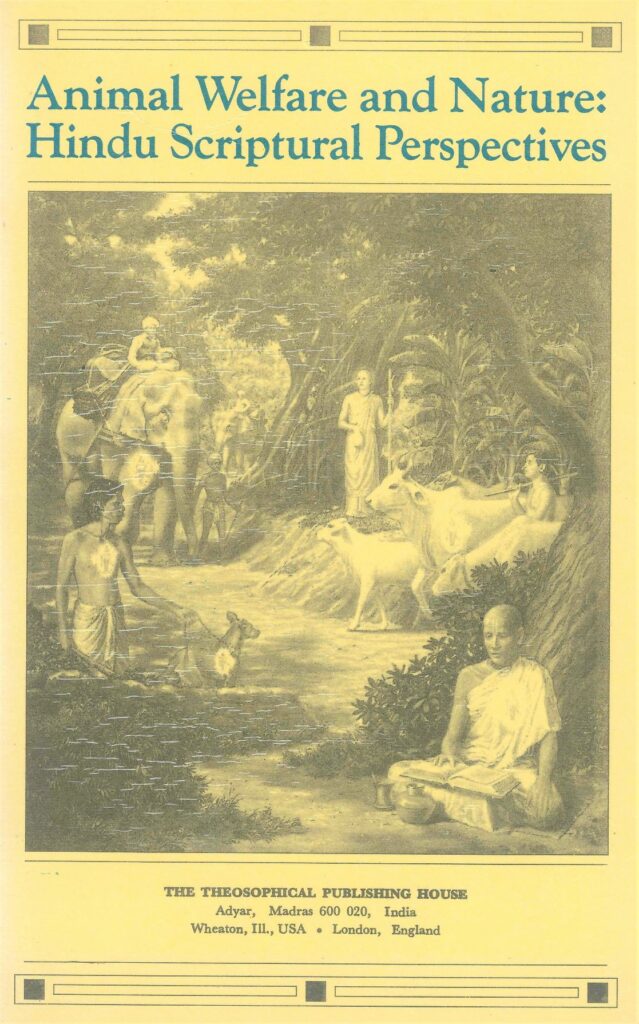
By G. Naganathan, Foreword by Dr. Karan Singh with an Introduction by Dr. Michael W. Fox.
30 Pages | This book was originally a publication of the Centre of Respect for Life and Environment, Washington. First edition 1991, second edition 2000. With illustrations | Softcover | The Theosophical Society, Adyar | No ISBN.
In the Hindu view of life, all creation is linked together by a golden thread, because all manifestation has sprung from the eternal Brahman – Ishvasyamidam Sarvam Yatkincha Jagatyam Jagat – as the Upanishad has it. The seers of the Vedas, therefore prayed for the Welfare not only of the human race but for all living creatures, including animals, and indeed even for such apparently inanimate objects as trees and plants. Animals have always played a central role in the Hindu perception. In its mythology every God and Goddess is associated with a particular animal as its vehicle or vahana.
From the Foreword:
” The point that emerges is that animals are not to be looked upon as creatures to be cruelly exploited but as partners with human beings in the spiritual adventure of living. Indeed, although hunting was also an old Hindu tradition, it is surely significant that in both our great epics, the Ramayana and the Mahabharata, tragedy should have been triggered by hunting episodes. The whole question of animals as bound to human beings in a benign symbiosis receives considerable attention in the Hindu scriptural tradition, the most popular of which, of course, became the cow, which is still looked upon by millions as sacred. “
The Language of MA – The Primal Mother: The Evolution of the Female Image in 40,000 Years of Global Venus Art

587 Pages | Published in 2013 | Softcover | Uitgeverij A3 Boeken | ISBN: 9789082031300.
This is the first pioneering study of global ‘Venuses’, who are part of an ancient and contemporary art traditionally called ‘Venus Art’ – the Art of Primal Mother(s), the Art of the female ancestors. Venus Art reflects the consciousness of egalitarian societies of peace, in which women and feminine values play or have played a central role, in which MA or the MATER or MOTHER and the primal mothers of the clan are central.
To date Venus Art has been understood, neglected and not integrally researched. The Art has become eroticised and sexualised. The purpose of this book is to rehabilitate Venus Art with Venus seen and honored as manifestation of the divine Mother MA.
From Chapter 2 – ‘The Book in a Nutshell’ (p. 15):
” Part 1 consists of eight chapters, part 2 the same. This is no coincidence. Three and four make seven. Seven plus one makes eight. In eight begins a new octave, a new time, a new mankind. In the lemniscate of the eight. the independent feminine and masculine come together in perfect balance. By bringing the forgotten feminine into the picture, balance and connection is created with the masculine. Unity. “
 More Details
 Remember MA • Welcome a new art historical approach that defi nitively maps the contribution of woman to evolution and brings to an end a male world history without women. • Remember the primal mothers, who much later were called ‘Venuses’ and sometimes pin-ups. This book rehabilitates them as the first leaders of humanity. • Learn about a global feminine system of symbols that shows an astonishing consistency and coherency. • Witness how prehistoric cultures produced much more feminine art than masculine art. • Understand why the feminine was pictured so often in old and modern female-friendly societies of peace and balance. • Learn to discern an ancient primal mother from a later goddess, priestess and worshipper. • See how a male system of symbols is laid over the older feminine system of symbols; now the female image is devalued and the world is changed in a valley of tears. • Meet the lost Lady of Old Israel in images and texts and see how she is transculturally transformed into Mary, the Lady of all Nations in Christianity. Dr Annine E.G. van der Meer (1953) is a Dutch historian of religion and holds a PhD in theology from the University of Utrecht. She is the author of several books. She has travelled widely to retrace the universal hidden Mother in sacred texts, art and symbols. She is founder and president of the Dutch PanSophia Academy, school of Wisdom, where she also teaches. In July 2010 33 women of international standing in their particular fields were honoured in the ‘Manifest Female Energy’. Annine van der Meer was one of six Dutch women to be decorated. According to the manifest, they have contributed to transformation processes in the world; a new world, in which feminine and masculine energies mutually inspire each other and are growing towards a new, powerful and creative world order.
The Real St. Nicholas: Tales of Generosity and Hope from around the World

Edited and translated by Louise Carus.
214 Pages | First Quest Edition 2020. ‘NAPRA Nautilus Award Grand Winner 2003’. | Softcover, with pictures | Quest Books, U.S.A. | ISBN: 9780835608138.
‘While Santa Claus just brings toys, St. Nicholas changes lives and brings real joy’!
The Real St. Nicholas is a jubilant celebration of spiritual values and the true meaning of the holiday season. Santa Claus is only a nickname. The historical Nicholas was a fourth-century bishop in what is now modern Turkey. Over time, tales of his goodness spread as far as Karelia, bordering Finland and Russia, throughout Europe. The Dutch brought him to the New World as Sinterklaas.
While slimmer than Santa, St. Nicholas is much larger in Spirit. He is the patron Saint not only of children, but also of sailors, bakers, bankers, prisoners, pharmacists, maidens, merchants and, New York City. But the traditions around him have been lost in America. Louise Carus restores this important image of the kind, wise Elder with rare stories from Spain, Greece, Italy, Ireland, Germany, The Netherlands, France, Russia and Armenia – among other countries. Most are simple folktales of powerful virtue. We hear of how Nicholas rescues orphans and soldiers, feeds the hungry, helps hapless lowers, outwits thieves and devils, and heals the ill and lame (including an ant!). An Afterword recounts modern legends of healing and rescue told by people living in Greece today.
The result is the best such collection available in English. It is a gift to all parents, educators, story loversm and others, who long to resanctify the holidays. There’s a story for each of the thirty-one days in December, but The Real St. Nicholas can inspire us on any day of the year.
Louise Carus, Ph.D., is a Jungian analyst and the editor of Betwixt and Between and Crossroads: two books on adolescent ‘rites of passage’ recognized as classics in the field.
From Chapter – ‘Signs of St. Nicholas Today’ (p. 191):
” A miller, Fragiadakis Mixales, who lives outside of Zaros, Crete, told us this story about his daughter. It happened when the girl was about four years old and suffering from epilepsy:
‘After my daughter had had several seizures, my wife took her to our nearby St. Nicholas monastery. She laid her down to sleep just at the entrance of the monastery under an olive tree and then went into the church to pray for her healing. When my wife returned to our daughter, the little one awoke and said: ‘And old man with a white beard came and touched my hand and told me, ‘You are well now”.’
My daughter never had another seizure. She is married now, with two children, and lives in Athens. This true story is well known in my community. “
More Details While slimmer than jolly old Santa, the historical saint is much larger in character. Celebrated as protector of the wronged and patron saint of children, Nicholas is, in essence, a Western bodhisattva: an enlightened being who serves those in need. This book restores him as an important lost archetype of the Wise Old Man, clustering stories according to such appealing themes as rescuing, nurturing, outwitting evil, and healing. Louise Carus spent two years researching and translating material to bring us the best collection available in English. It will delight parents, educators, community organizers, story lovers, and others eager to decommercialize and resanctify the holidays. Indeed, the generous spirit of the real St. Nicholas can inspire us any day of the year. “Everyone who loves a good story will want to add this book to their collection. Parents will find family values and children will discover delight in goodness all through these warm tales.” — Father Gabriel Bullock, OSB, St. Bede Abbey, La Salle, Illinois “In collecting this wonderful cauldron of stories, old and new, Louise Carus has done a great service to all who love the festival of Christmas. A much needed, “must read” book!” — John Matthews, author of The Winter Solstice
De Chakra’s

By Charles Webster Leadbeater (1854 – 1934).
126 Pagina’s | Eerste druk 1931, zevende druk 2007 | Softcover | Uitgeverij der Theosofische Vereniging in Nederland | ISBN: 9789061750741.
Dit is de Nederlandse vertaling van het Engels origineel: The Chakras – The Original Monograph based on Clairvoyant Investigations | First edition 1927, 15th reprint 2006 | Theosophical Publishing House, Adyar. | ISBN: 8170590582.
De Chakra’s is gebaseerd op zeer zorgvuldige helderziende waarnemingen van het zogenaamde etherische of levenslichaam dat het fysieke lichaam van de mens omhult. Het legt verband met Indiase geschriften waarin beschrijvingen van deze centra voorkomen. Bovendien bevat het een aantal unieke kleurenillustraties van de chakra’s, die op aanwijzing van de helderziende auteur zijn samengesteld.
Sinds dit werk in 1927 voor het eerst verscheen is het in vele landen een bestseller geworden. Deze editie is geheel herzien en opnieuw vormgegeven. C.W. Leadbeater was een bekend theosofisch auteur, die in zijn vele boeken beschrijvingen gaf van zijn eigen helderziende waarnemingen.
Afkomstig van bladzijde 17:
” De chakra’s of krachtcentra zijn verbindingspunten, waardoor een kracht van het ene voertuig of lichaam van de mens naar het andere stroomt. Ieder, die maar een geringe graad van helderziendheid bezit kan ze gemakkelijk in het etherisch dubbel zien, waar zij zich vertonen als op schotels gelijkende inzinkingen of draaikolken aan de oppervlakte. Wanneer zij nog volkomen onontwikkeld zijn, lijken zij op cirkeltjes van ongeveer vijf centimeter middellijn, die bij de gewone mens dof lichten; wanneer zij echter zijn opgewekt en belevendigd zijn, ziet men ze als vlammende, flonkerende draaikolken, die zeer in grootte zijn toegenomen en op kleine zonnen lijken. “
More Details Dit boek is wereldwijd het best verkochte theosofische werk van de afgelopen eeuw. Leadbeater werkte voor het eerst een begrijpelijke terminologie uit over de chakra’s – al het daarop volgende werk is op zijn pionierswerk gebaseerd. Het boek bevat een aantal unieke kleurenillustraties van de chakra’s, die op aanwijzing van de helderziende auteur zijn samengesteld. De belangstelling voor oosterse filosofie is nog steeds groeiende. De hierin voorkomende visie op de mens is voor velen een welkom alternatief voor het materialistische mensbeeld. Vooral over de innerlijke opbouw van de mens is in de oosterse filosofie veel bekend. Tot de meest aansprekende onderwerpen op dit gebied behoren de chakra’s of energiecentra in de mens, die van groot belang zijn voor zowel zijn lichamelijke gezondheid als zijn geestelijk evenwicht.
Adyar – The International Headquarters of the TS

By an anonymous author.
36 Pages | First edition, first reprint 2012; with pictures | Softcover | Theosophical Publishing House, Adyar | ISBN: 8170592631.
The work of the Theosophical Society involves a way of life, which leads to Self-knowledge and knowledge of the Laws of being. Only when man begins to act, think, feel, and ‘be’ in accordance with the unchanging and unchangeable Laws, which pervade and regulate all things in the visible as well as the invisible worlds, does his psyche permit spiritual energy to flow through the hidden depths. Both individual regeneration and the reordering of human society in such a way that harmony, freedom and creativity flourish, depend on discovering the right way of living.
From Chapter 1 – ‘Early History’ (p. 1):
” A significant day in the history of the Theosophical Movement was 17 November 1875, for it was on that day that Madame H.P. Blavatsky and Col. H.S. Olcott founded the Theosophical Society. The venue was New York. However, it was soon apparent to them that India was to become the centre of the Society’s activities, and so they travelled to Bombay, arriving there on 16 February 1879, and from there they began to look for a suitable place for the Headquarters of the Society. On 31 March 1882, the Founders arrived in Madras and soon found a site called Huddleston Gardens on the South bank of the Adyar River. Their very first glance told them that ’their future home was found’. There were twenty-eight acres of wooded land and gardens surrounding a large bungalow and two smaller ones; and the price, and affordable Rs 8.500,- – a low price even for those days – was met through loans from members in the Society. They moved in on 19 December 1882 and on 1 January 1884 had repaid the loans. “
The Chaldean Account of Genesis

By George Smith (1840 – 1876).
319 Pages | Secret Doctrine Reference Series 1977; photographic reproduction of 1876 edition, with illustrations | Hardcover | Wizards Bookshelf, San Diego, U.S.A. | ISBN: 0913510661.
The complete title of the work is:
The Chaldean Account of Genesis – Containing the Description of Creation, the Fall of Man, the Deluge, the Tower of Babel, the Times of the Patriarchs and Nimrod; Babylonian Fables, and Legends of the Gods; from the Cuneiform Inscriptions.
George Smith (1840 – 1876) was an English Assyriologist, who earned worldwide fame in 1872 by his translation of the Chaldaean account of the Deluge, which was read before the Society of Biblical Archaeology on the 3rd of December.
From Chapter I – ‘The Discovery of the Genesis Legends’ (p. B):
” The fragments of the Chaldean historian Berosus, preserved in the works of various later writers, have shown that the Babylonians were acquainted with traditions referring to the Creation, the period before the Flood, the Deluge and other matters forming part of Genesis. “
Buddhism – An Outline of Its Teachings and Schools (Theravada, Mahayana, Vajrayana)

By Hans Wolfgang Schumann.
200 Pages | First Quest edition 1974 | Paperback | Quest Books, U.S.A. | ISBN: 0835604527.
WITH 39 DRAWINGS AND PHOTOS.
Both general readers and serious students of Buddhism will welcome the systematic arrangement of material, which makes this book a reliable guide through a vast field of thought. The author worked from original texts, and his work contains many original observations. Of special value is a Tabulated Synopsis of the major systems of Buddhism enabling the student to grasp, almost at a glance, the fine distinctions between them.
From its Preface:
” Five hundred years before the rise of Christianity there originated in India a religious doctrine, which does not make a god or the gods the subject of its thinking , but concentrates on man himself as interwoven with the cosmic cycle. As its author, Siddhattha Gotama, the ‘Buddha’, was convinced of having revealed in this teaching a natural law, he calls it ’the law’ (p: dhamma, Skt: dharma), thereby simultaneously characterising it as a rule for human behaviour. Aptly, his followers chose the wheel (P: cakka, Skt: cakra) as symbol of the dharma: a symbol of functional unity, of pivotal standstill in movement and, in ancient India, of righteous royal rulership.
[…]
The twenty-four wheel symbol of the righteous ruler (cakkavatin) belongs to the lion-capital of the pillar erected in Sārnāth by Emperor Asoka in the 3rd century B.C. The edict carved in the pillar warns against schism of the monastic order. The lion-capital is today India’s national coat of arms; the wheel was incorporated in the Indian national flag. As a Buddhist symbol, the ‘wheel of the teaching’ may have eight to thirty-six spokes. ”
Tibetaans Boeddhisme – Een Verzameling Studies

Redactie: Ir. H.E. Ch. Poortman, Dr. J.H. Dubbink en Drs. R. Engelse.
93 Pagina’s | Uitgegeven in 1975 | A4-formaat softcover incl. illustraties | Uitgeverij der Theosofische Vereniging in Nederland, Amsterdam | ISBN: 0906175038.05.
Deze publicatie ziet het licht tijdens de viering van het 100-jarig jubileum van de internationale Theosophical Society. Moge zij bijdragen tot een juist inzicht in de oorsprong en het doel van het theosofisch werk, geworteld als het is in bepaalde universele leringen van het Tibetaans Boeddhisme. En moge zij helpen bij de verspreiding van mededogen en broederschap tot geluk van alle wezens.
Deze uitgave bevat een verzameling studies van diverse auteurs over de volgende onderwerpen:
- De Dalai Lama en zijn boodschap
- De Dalai Lama als mens
- Tibetaanse mystiek
- Dharmacakra, het levensrad van het bestaan
- Het Tibetaanse Dodenboek van leven en sterven
- Het Pad van de Bodhisattva
- Tibetologie
- Brieven van De Meesters
- Erkenning van de esoterische school
- De Mahatma’s over Tibet
- Het Vajrayana (tantrisch) Boeddhisme
- De zeven menselijke beginselen.
Animal Welfare and Nature: Hindu Scriptural Perspectives (Second Edition)

By G. Naganathan, Foreword by Dr. Karan Singh with an Introduction by Dr. Michael W. Fox.
30 Pages |This book was originally a publication of the Centre of Respect for Life and Environment, Washington. First edition 1991, second edition 2000. With illustrations | Softcover | Theosophical Publishing House, Adyar | ISBN: 8170594170.
In the Hindu view of life, all creation is linked together by a golden thread, because all manifestation has sprung from the eternal Brahman – Ishvasyamidam Sarvam Yatkincha Jagatyam Jagat – as the Upanishad has it. The seers of the Vedas, therefore prayed for the Welfare not only of the human race but for all living creatures, including animals, and indeed even for such apparently inanimate objects as trees and plants. Animals have always played a central role in the Hindu perception. In its mythology every God and Goddess is associated with a particular animal as its vehicle or vahana.
From the Foreword:
” The point that emerges is that animals are not to be looked upon as creatures to be cruelly exploited but as partners with human beings in the spiritual adventure of living. Indeed, although hunting was also an old Hindu tradition, it is surely significant that in both our great epics, the Ramayana and the Mahabharata, tragedy should have been triggered by hunting episodes. The whole question of animals as bound to human beings in a benign symbiosis receives considerable attention in the Hindu scriptural tradition, the most popular of which, of course, became the cow, which is still looked upon by millions as sacred. “
The Summer Solstice – Celebrating the Journey of the Sun from May Day to Harvest

John Matthews, Foreword by Caitlin Matthews.
144 Pages | First Quest Edition 2002 | Hardcover, incl. Illustrations | Quest Books, U.S.A. | ISBN: 0835608158.
The sun is universally acknowledged as the source of all life, fertility, and good fortune, and so has been worshipped by all cultures across the earth. The Summer Solstice brings together myth and legend and offers new and old ways of celebrating the turning of the seasons.
Here we find a celebration of the customs and ceremonies of May Day, Midsummer and Harvest, as observed the world over. The deep and timeless themes underlying the characters of the Lord and Lady of the Summer are explored. Learn how the May Day revels were celebrated; discover the history of the Maypole and the myths behind the Midsummer games. And read how the establishment of the May King and Queen symbolized the struggle between Summer and Winter. Understand the significance of Midsummer’s Eve and the fairy people, and enjoy the ancient story of the death and resurrection of the corn Goddesses and Gods, passed on at Midsummer when ripening corn became the life-enhancing drink of Initiates and dancers.
Resplendent with full-color illustrations, each chapter includes songs, activities, recipes and meditations to help readers relate to the natural world in a meaningful and fun way. In a spirit of revelry, Matthews also provides full instructions for how to produce a Midsummer feast and a Harvest home fete. Families and folklore enthusiasts alike will enjoy this informative and entertaining sourcebook!
From Chapter 2 – ‘Gods and Heroes of Summer (p. 62):
A Midsummer Blessing at Stonehenge
” Though the thin rain lash the broad plain
And the sword-blade’s rimmed with mist,
Shake the bright light from the short night
Kiss the hele-stone in ancient tryst.Thought the long tracks know no glad step
And the circle go unblessed,
From their long homes may the old ones
Welcome travelers upon their quest.Though the keepers great no reaper,
And the grasses grow high,
May the Corn King dance his crop sign
In the barley, wheat and rye.Though remembrance be a semblance
And the land thrums with wrong,
May the hele-stone be the leal throne
Where the sun awakens song.Chorus:
Sun-stone’s kiss, Midsummer’s pleasure,
Welcome all and some.
At the hele-stone sing and gather,
Every blessed one. “
- Caitlin Matthews.
De Mens – Zichtbaar en Onzichtbaar / Gedachtevormen

Door Charles Webster Leadbeater (1854 – 1934).
174 Pagina’s met 30 gekleurde platen | 1902 Met de eerste druk in 1903, 2de geheel herziene druk 2009 Hardcover | Uitgeverij der Theosofische Vereniging in Nederland, 2009 | ISBN: 9789061750901.
English Original: Man Visible and Invisible | First edition, 10th reprint 2008 | Hardcover | Theosophical Publishing House, Adyar | ISBN: 9788170595526.
Dit boek is een inspirerende gids voor de serieuze zoeker naar de realiteit achter en in onze zichtbare werkelijkheid. De auteur was een begaafde en geoefende helderziende onderzoeker.
Aura’s en gedachtrvormen behoren tot het ‘onzichtbare’. De mens is altijd naar het onzichtbare op zoek geweest, maar heeft daarbij vaak in het duister moeten tasten, doordat zijn ontwikkeling steeds materialistischer en zakelijker werd – zelfs op het gebied van het spirituele. Het doorgronden van het mysterie van de relatie tussen het zichtbare en het onzichtbare is slechts weinigen gegeven. Het vergt oefening in de eerste plaats en een buitengewone gevoeligheid. Zo is dat altijd geweest en zo is het nog steeds.
Af en toe komen we iemand tegen wiens vermogen tot het waarnemen van het onzichtbare op ons een onuitwisbare indruk maakt. Schrijver en helderziende Charles Webster Leadbeater is zo iemand. In de geschiedenis heeft hij nog niemand zoals hij helderziend onderzoek gedaan en dat vervolgens met afbeeldingen in een boek samengebracht. Leadbeater is wat dat betreft ongeëvenaard. Dit is het werk over aura’s en gedachtevormen. Het kan worden gezien als de tegenhanger van het eveneens door Leadbeater later geschreven, baanbrekende werk De Chakra’s (1927). Het is een inspirerende gids voor de serieuze zoeker naar de realiteit achter en in onze zichtbare werkelijkheid. Meer dan een gids kan het uiteraard niet zijn, omdat de lezer ten allen tijde op zijn of haar eigen intuïtie en waarnemingsvermogen zal moeten afgaan.
Afkomstig van bladzijde 28 & 29:
” De naam ‘astraal’ is niet door onszelf gekozen; wij hebben hem geërfd van de Middeleeuwse alchemisten. Hij betekent ‘sterachtig’ en men gelooft dat hij is toegekend aan de stof van het gebied dat het eerst komt boven het stoffelijke vanwege het lichtgevende voorkomen, dat wordt verbonden met de grotere snelheid van haar trilling. Het astrale gebied is de wereld van de hartstocht, van emotie en sensatie; en door het voertuig van de mens op dit gebied is het, dat al zijn gevoelens zich aan de helderziende onderzoeker vertonen. Het astrale lichaam van de mens verandert daarom voortdurend van uiterlijk naarmate diens aandoeningen wisselen. “
More Details Aura’s en gedachtevormen behoren tot het ‘onzichtbare’. De mens is altijd naar het onzichtbare op zoek geweest, maar heeft daarbij vaak in het duister moeten tasten, doordat zijn ontwikkeling steeds materialistischer en zakelijker werd – zelfs op het gebied van het spirituele. Het doorgronden van het mysterie van de relatie tussen het zichtbare en het onzichtbare is slechts weinigen gegeven. Het vergt oefening in de eerste plaats en een buitengewone gevoeligheid. Zo is dat altijd geweest en zo is het nog steeds. Af en toe komen we iemand tegen wiens vermogen tot het waarnemen van het ‘onzichtbare’ op ons een onuitwisbare indruk maakt. Schrijver en helderziende C.W. Leadbeater is zo iemand. In de geschiedenis heeft nog niemand zoals hij helderziend onderzoek gedaan en dat vervolgens met afbeeldingen in een boek samengebracht. Leadbeater is wat dat betreft ongeëvenaard. Dit is het werk over aura’s en gedachtevormen. Dit bijzonder originele en authentieke boek is voor het eerst verschenen in 1902, in een tijd waarin het publiek nog amper iets over aura’s en gedachtevormen had vernomen. Het kan worden gezien als de tegenhanger van het eveneens door C.W. Leadbeater later geschreven, baanbrekende werk De Chakra’s. Het is een inspirerende gids voor de serieuze zoeker naar de realiteit achter en in onze zichtbare werkelijkheid. Meer dan een gids kan het uiteraard niet zijn, omdat de lezer te allen tijde op zijn of haar eigen intuïtie en waarnemingsvermogen zal moeten afgaan. Aan het einde van het boek is het artikel Gedachtevormen van Annie Besant toegevoegd.
The Personal Aura (with 19 Full Color Illustrations)

By Dora van Gelder-Kunz (1904 – 1999).
195 Pages | A Quest Original, first edition 1991, second printing 1996 | Softcover | Quest Books, U.S.A. | ISBN: 0835606716.
This book, an original study of the human aura, includes 19 paintings that depict the emotional energies, which surround each person. The changes that occur from infancy to old age are illustrated by the auras of specific people. The pictures also show changes, that occur in the aura in illness. The author worked with Juanita Donahoo to produce the striking paintings in full color. The Personal Aura presents a fresh view of these subtle aspects of the human constitutionm which are hidden from most of us. It offers helpful suggestions for changing difficult emotional patterns.
From Chapter 8: ‘Healing and the Possiblities for Change and Growth’ (p. 166):
” The effects of healing upon the patient’s aura can be quite dramatic. First, the influx of emotional energy causes the aura to expand. When this happens, it starts up the process of eliminating some of the disturbances and blockages in the aura, and thus reduces anxiety. Anxiety produces frightening mental images. But if imagery is used together with the healing, there will be a simultaneous effect; the immune system will be strengthened through the influx of etheric energy, and as the frightening image dissipate, the aura will slowly regain its integration and recover its health. ”
. . . Een Kern van Broederschap – 100 Jaar Theosofische Vereniging in Nederland 1897 – 1997

Door Ruud Jansen.
228 Pagina’s | Jubileumboek, uitgegeven in 1997 | Hardcover, incl. Noten, Register & Illustraties | Uitgeverij der Theosofische Vereniging in Nederland, Amsterdam | ISBN: 906175725.
The Theosophical Society werd in 1875 opgericht te New York door Helena Petrovna Blavatsky (1831 – 1891) en enkele anderen. De belangrijkste doelstelling van deze vereniging is het vormen van een kern van Broederschap zonder onderscheid van ras, geloof, geslacht, kaste of huidskleur. Daarnaast heeft men zich het aanmoedigen van een vergelijkende studie van godsdienst, filosofie en wetenschap en het onderzoeken van de vermogens, die in de mens sluimeren ten doel gesteld.
Sinds 1878 is het Hoofdkwartier van deze internationale vereniging gevestigd te Adyar, Madras, India. De Theosofische Vereniging in Nederland – de Nederlandse Afdeling van de Theosophical Society – werd in 1897 opgericht. Dit boek bevat het verhaal van honderd jaar Theosofie in Nederland. In de vorige eeuw hadden in het Westen nog maar weinig mensen gehoord van begrippen als yoga, karma, reïncarnatie, aura’s en chakra’s. Het is de verdienste geweest van Mevr. Blavatsky dat deze termen nu gemeengoed geworden zijn in onze cultuur. Vooral in de wereld van de New Age wordt veelvuldig geput uit Theosofische bronnen.
In Nederland is de Theosofische Vereniging na een bloeiperiode in de twintiger jaren van de 20ste eeuw, nu veel minder bekend dan de talloze New Age groeperingen, die de laatste decennia zijn opgekomen. Vanwege haar honderdjarig bestaan is zij echter in staat te verwijzen naar diepere achtergronden en een samenhangend esoterisch wereldbeeld te schetsen.
Afkomstig uit Hoofdstuk 1 – ‘Inleiding’ (blz. 11):
” De Theosophical Society werd opgericht om allen samen te brengen, die een helder inzicht trachten te verkrijgen in de ware aard van de mens en de samenstelling van het universum. De Society streeft drie doeleinden na:
- Het vormen van een kern van de Universele Broederschap der Mensheid zonder onderscheid van ras, geloof, geslacht, kaste of huidskleur.
- Het aanmoedigen van de vergelijkende studie van godsdienst, wijsbegeerte en wetenschap.
- Het onderzoeken van de onverklaarde natuurwetten en van de vermogens, die in de mens sluimeren.
De Theosophical Society kent geen vastomlijnde leer of dogma’s, maar biedt wel een aantal thema’s aan, die als uitgangspunt kunnen dienen voor persoonlijke geestelijke ontwikkeling. “
Dieren in de Woonomgeving – De Bevordering van de Huisvesting van Niet-Huisdieren in de Woonomgeving

Door Michiel Haas.
64 Pagina’s | Uitgegeven in 2003, incl. afbeeldingen| NIBE Publishing- (Nederlands Instituut voor Bouwbiologie en Ecologie), Bussum | ISBN: 9074510086.
Dit is Deel 3 uit de Serie ‘Duurzaam & Gezond Bouwen’.
Het is, door de juiste planten, struiken en bomen aan te planten, mogelijk om in onze onmiddellijke nabijheid natuur te realiseren. Bepaalde soorten trekken bepaalde diersoorten aan. Ook met natuur- en bouwkundige voorzieningen is het mogelijk de aanwezigheid van bepaalde diersoorten te reguleren. Om te bepalen in welke omgeving en onder welke omstandigheden dit dient te gebeuren is echter wel enige kennis van de biologie van dieren en de ecologie vereist.
Dit boekje wil deze kennis op een praktische manier beschikbaar maken, zodat particulieren, maar ook architecten, opdrachtgevers, ontwikkelaars en gemeenten, aan de gang kunnen gaan met het scheppen van stukjes natuur in de directe verblijfsomgeving. Het gaat iedereen aan. We kunnen er meteen mee aan de slag, in het ontwerp, maar ook in de uitwerking. Iedereen kan zijn tuin aanpassen, (meer) planten op het balkon of dak zetten, of gevels laten begroeien. Op die manier kunnen we, met de juiste middelen, de natuur weer dichterbij halen. Hoe meer natuur we in onze directe omgeving aanbrengen, hoe meer verschillende diersoorten we na verloop van tijd zullen aantreffen.
Afkomstig uit de Inleiding (p. 5):
” Veel huizen hadden vroeger een mooi rond gat in het puntje van het dak, bedoeld om de geesten, die zich bij voorkeur in de dakbalken ophielden, naar binnen en naar buiten te kunnen laten gaan. Ook de ziel van de overledenen konden op die wijze het huis verlaten. Dat die openingen ook gebruikt werden door kerkuilen en vleermuizen is een bijkomende zaak. Maar door de verandering van de gewoonte om de geesten niet meer die weg te gunnen, zijn veel nestgelegenheden verloren gegaan. “
The Astrology Of Accidents – Investigations and Research

By C.E.O. Carter.
123 Pages | First published in 1932, reprinted in 1978 | Softcover | Theosophical Publishing House, London | ISBN: 722950594.
One of the most important areas in looking at a horoscope is interpreting from the aspects indications of possible accidents; and the subject is made all the more difficult by defining what constitutes an accident. The author defines it as ‘a bodily mishap occasioned without intent either on the part of the sufferer or the agent (if any) inflicting it’. There are various gradations of accidents, and in the research for this book, one of the primary considerations was to discover if possible any factors that are common to all serious accidents. Here with the evidence of statistics are 168 cases from Britain and the United States, which will assist astrologers in examining charts.
From the ‘Preliminary Considerations’ (p. 17):
” Our first investigations must be directed to discover, it possible, any factors that are common to all serious accidents, or at least occur more frequently than mere probability would explain. My total collection, at the time of ‘closing the lists’ for tables, comprised 168 cases. These may be roughly divided as follows: asphyxiation (5), drowning (14), burns (19), scalds (9), gunshots (4), blows (21), crushings (9), wounds and cuts (7), vehicular (22), falls (32), machinery (5), railway (3), poisons (1), explosions (4), miscellaneous (10) and animals (3). Some of this book was written before all of these had come to hand, hence the above figures may not exactly agree with others given in Part Two, which also contains cases that came in after the tables had been finished. “
More Details C.E.O. Carter (1887 – 1968) was the most outstanding British astrologer of the 20th century. After the death of Alan Leo, Carter ran Leo’s Astrological Lodge at the Theosophical Society, from 1920 to the 1952. He was first Principal of the Faculty of Astrological Studies, which he helped found in 1948. He edited The Astrologer’s Quarterly from 1926 until 1959. Carter’s books, penetrating & full of unique insights, are ideal for intermediate & advanced astrologers. They are, in fact, virtually in a class by themselves. Instead of a book on synastry, or forecasting, or horary or elections, Carter’s books are organic wholes. Instead of treating aspects in one chapter, signs in another, and planets in a third, Carter shows how individual astrological factors combine to create living, breathing people. For example, Carter tells us that a cardinal grand cross has one sort of effect if it falls in succedent houses, quite another if it falls angular. It is this constant interplay of factors, and Carter’s brilliant, lucid exposition, that makes his books so precious.
 Updating…